
Feteasca Neagră @ SERVE

Our story, our terroir, our people
For us, Feteasca Neagră is not just a valuable local variety. It is the point from which everything began at SERVE.
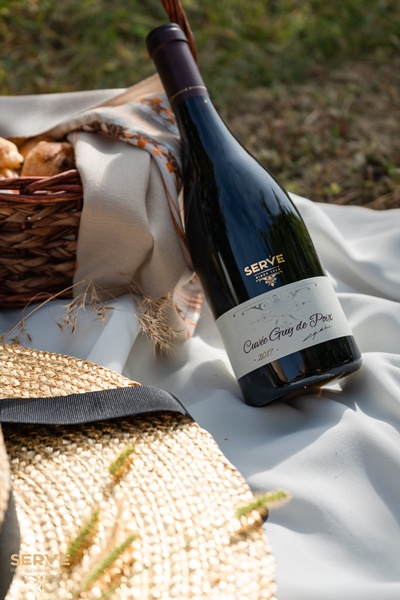
In 1994, when Guy de Poix arrived in Dealu Mare, he tasted a Feteasca Neagră straight from the vessel, in a modest winery, after a difficult year. It was not a spectacular context. But the wine had strength, structure, identity. His reaction was immediate: “This is the wine I want.”
It was not a romantic decision. It was a strategic intuition driven by confidence in Romania’s flagship variety in the Dealu Mare terroir.
Why Dealu Mare?
A choice of terroir, not of opportunity
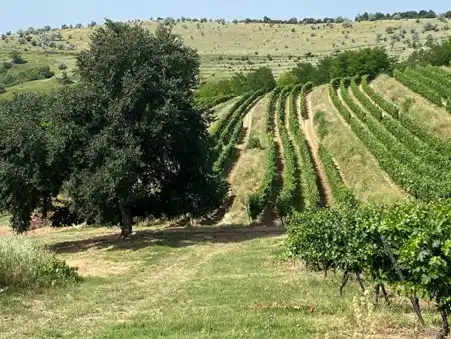
Dealu Mare is one of the warmest wine-growing regions in Romania, with a pronounced continental influence: hot and dry summers, long autumns, day-night temperature differences that favor the accumulation of sugars without the complete loss of acidity.
The dominant soils – clayey-calcareous, with marl, loess and gravel inclusions – have good drainage and a balanced water retention capacity. For Feteasca Neagră, this is essential. The variety has medium to high vigor, but is sensitive to excess production and canopy humidity. In compact or overly fertile soils, it can become diluted; in well-drained soils, with moderate limitation of vigor, it concentrates polyphenols and develops a solid tannin structure.
The roots that penetrate deep into the calcareous profiles contribute to the stability of acidity and the fineness of tannins. In favorable years, Feteasca Neagră from Dealu Mare develops high color density, structure and real aging potential.
It is no coincidence that international authorities have noted the specificity of the area.
Caroline Gilby has repeatedly highlighted Dealu Mare’s potential for structured red wines and for affirming Feteasca Negre as Romania’s flagship variety.
In the works coordinated by Jancis Robinson and Hugh Johnson, Feteasca Neagră is mentioned as the most promising native red variety, and Dealu Mare as one of the regions where they expressed the most coherent character.
For us, these validations came later. Guy felt this from the first glass.
Aurel Rotărescu
and the construction of style
Guy was with Aurel Rotărescu from the very beginning. Together they built the SERVE style around a simple principle: Feteasca Neagră takes time.
You can’t get a great wine from a 3–4 year old vineyard. The variety requires maturity of the plantation, strict yield control, careful canopy management and precise interventions at key moments of the season. The balance between phenolic maturity and acidity preservation is critical.
Under Aurel’s coordination, each plot was understood in depth: exposure, soil texture, reaction to water stress, behavior in dry years versus cold years. Feteasca Neagră is not a “comfortable” variety. But, when respected, it rewards with wines of great expressiveness.
International recognitions – including scores of over 90 points – confirmed that the chosen direction was correct. But the real satisfaction remains the fidelity to the initial vision.
Continuity
After Guy’s disappearance, the responsibility became even greater.
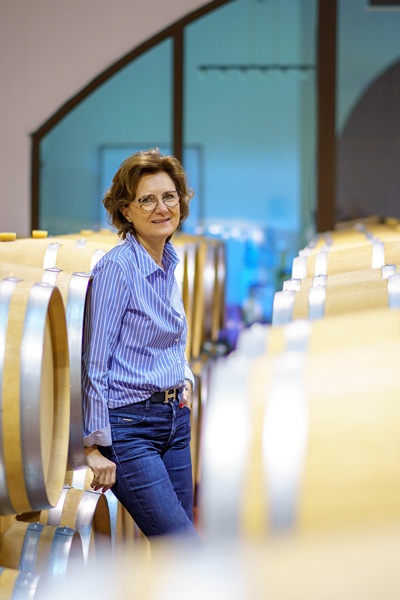
Mihaela de Poix continued the path started in 1994, maintaining the balance between tradition and evolution. For us, continuity does not mean stagnation. It means deepening.
Today, Feteasca Neagră remains the core of our identity. Not because it is a “trend” but because it is part of SERVE’s DNA.
We grew up with this variety.
We taught him, we shaped him, he shaped us. And we believe that, somewhere, Guy knows that the choice made in the fall of 1994 continues to tell, year after year, the same story: that Feteasca Neagră from Dealu Mare can stand with dignity in an international context – when it is understood, respected and carried through to the end.